What is the Facebook Page Recommendation Suspension and What Impact Will it Have on my Winery?
PLEASE NOTE: As you read this, keep in mind that this is all very new and we’re basing the following on reviewing many pages that we manage, our experience, and the little that we know from Facebook. We’ll update this post if/when new information comes in.
We’re getting a lot of questions about Facebook’s recent decision to stop recommending the pages of alcohol brands. It all started about a week ago when we saw some of the accounts we manage receive an email with the subject line:
(Your Page Name): Your Page doesn’t qualify for recommendation
Your Page, (Your Page Name), didn’t follow the rules, so it isn’t being suggested to other people right now.
That’s it. No explanation. No reason why.
If you check your page’s status, it’ll most likely say there are no issues. It appears that, either intentionally or through error, Meta (or the Meta AI overlords) have decided to squash alcohol brands’ ability to have their pages recommended.
What Does Page Recommendation Suspension Mean?
This is where things get confusing. We can make the assumption that your Facebook page will no longer be recommended for people to follow. But what about individual posts? Will they stop being shown to non-followers as “Suggested for You” content? Let’s break down what we know and what we don’t know.
Your Page Will No Longer Be Recommended
Your Page entity won’t be recommended for people to follow. This will have the following effect on Facebook users:
- “Pages You May Like” – Your page won’t appear here.
- “Suggested Pages” – Won’t show up in these suggestions.
- Search ranking – Likely demoted or excluded from prominent results. This is TBD.
- Related page suggestions – When someone likes a similar winery, yours won’t be suggested.
Effect: You can’t organically gain new followers through Facebook’s discovery mechanisms.
Individual Posts?
Whether your individual posts still get shown to non-followers as “Suggested for You” content in feeds remains to be seen, and we’ll show you a way (see screenshots below) to keep track of this over the next few weeks/months.
Here are the unknowns based on looking at many of the Facebook pages we manage and their follower vs. non-follower reach.
- Inconsistent data – Some pages are affected, others are not. (And yes, we checked if it has to do with the page being set to over 21).
- Gradual Rollout – Maybe some pages that don’t seem affected now will be in the future, as it may be a rolling deployment after you receive the initial notification.
- Buggy – Let’s be honest. What about Meta screams competency? Perhaps it’s just buggy right now and consistent implementation will eventually take place.
- Content-type dependent – We’re keeping an eye on the types of posts that still seem to get non-follower reach.
The Good News – What is Still Working
- Posts appearing in existing followers’ feeds – algorithmic surfacing to your followers continues.
- Social/viral reach – shares, tags, check-ins. Even if the algorithm no longer will be suggesting posts (this is TBD, see below), getting your followers to like, share, comment on posts will still get your post into their friend’s feeds.
- Direct page visits.
- Facebook Groups posts.
- Search – though possibly demoted.
How to Keep an Eye on Follower vs. Non-Follower Views
Over the next few weeks or months, we recommend you check your individual posts for follower vs. non-follower views. How?
- Log in to Facebook
- “Switch” to manage your page
- Click “Professional Dashboard”
- Click “Insights”
- Click “Views”
You should see this:

Obviously, your stats will be different, but take a look at the, “Views by followers vs. non-followers.” This is completely irrelevant! Ha. Got you. Okay, it’s irrelevant if you’re running any sort of Meta ad. This aggregate data includes paid ads, so if you’re running Meta ads, it won’t tell you about organic non-follower reach. For organic-only data, you need to look at individual posts below.
If you’re not running any Meta ads, then this data is actually useful. Keep an eye on that non-follower percentage. Are you still reaching them? How about in a month?
Individual Post – Non-Followers
This is where the data is actually important and what you should be keeping track of:
- Locate the “Recent Posts” section near the bottom of the page.
- Start clicking through posts
- Look at “Followers vs. Non-Followers”
- Look at “How people find your content” and then click on “source” (note, not all of our clients have data in this section, so it’s okay if you don’t…thanks, Facebook)
- NOTE: This data will include ad data if you’ve boosted the post. So, be sure you’re looking at non-boosted posts.
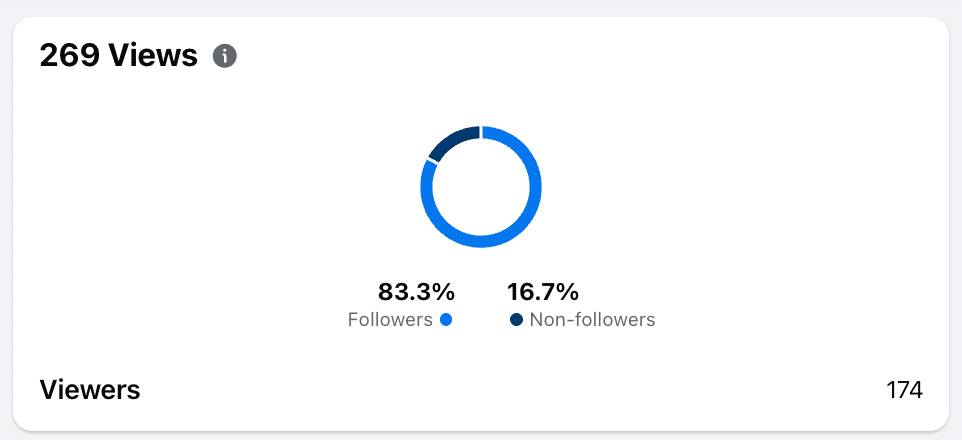
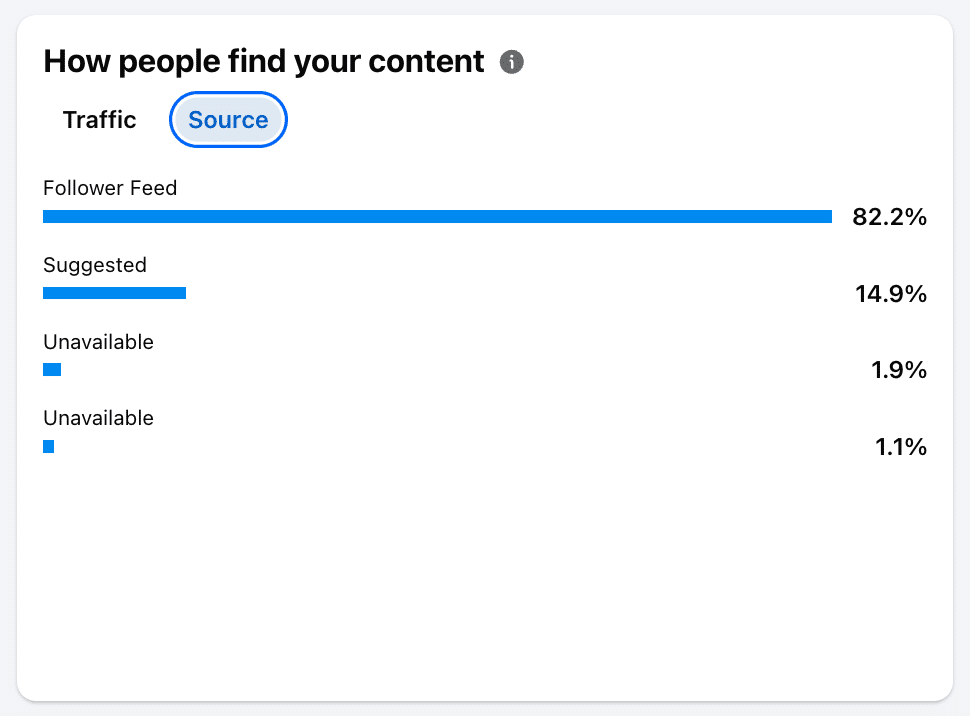
What you’re looking at above is an individual post’s data. This is from a page that definitely got the suspension and there was no ad money behind the post (we didn’t boost it). This post was made 4 days AFTER the suspension email was sent. So, you can see the confusion.
According to the data, this post reached 16.7% non-followers. Great. But was that because our followers liked or shared it? Sure, that may be part of it. But take a look at the second image, the “source.” It shows that 14.9% of the people who found the content did so because it was “suggested”. This is the algorithm continuing to suggest a page’s content (post) even if the page itself is no longer recommended.
This is good news, but you need to keep an eye on your own data.
Next Steps in Tracking the Data
At this point, the best thing you can do is look at each individual post a day or two after it’s posted (give it some time to gather data). Look for any increase or decrease in non-follower activity. Look to see if your “suggested” source starts to decline. If you see things are pretty steady over the next few weeks, you can probably assume that the Page Recommendation Suspension only applies to the page itself and the items mentioned above in the, “Your Page Will No Longer Be Recommended” section. If, however, you see zero non-follower activity we may be seeing the rollout of the suspension of posts reaching a non-follower segment.
What About Ads?
With few exceptions, we’ve been running Meta ads for our clients for years. They are particularly good at bringing awareness to, and reservations for, tasting room experiences and events. Ads allow you to target whomever you want, breaking through any restrictions Meta is placing on organic reach and discovery.
While this “Page Recommendation Suspension” is the latest blow to a winery’s ability to be discovered on Facebook, it shouldn’t come as a surprise. Investing some ad dollars into posts or using the Meta Ads Manager to run ads is something that most of you are already doing, so tactically, things aren’t going to change a whole lot.
The only thing that could really help at this point is getting your current followers to interact with your posts more by posting good content that they will want to like, share, or save.
The best practices of engaging with others, commenting on other business’s posts, and sharing other local business’s or associations content still applies.
Is There Anything Else to Keep in Mind?
Great question, dear reader! Here are a few things we’re tracking and thinking about:
- As of now, this is Facebook only. We are keeping an eye on Instagram.
- Will this bleed over into ads?
- Good content is good content. Don’t get discouraged by the lack of discovery on Facebook. A solid social media plan and content generation can go on so many different platforms, so don’t stop striving to give your customers great content and helpful information.
- Discovery can happen in so many places. Make sure you are buttoned up on all of your association listing pages, Google Business page, review sites, etc.
- With AI (ChatGPT, Gemini, Claude, etc.) taking up a good chunk of search these days, your winery’s discovery is more tied to being mentioned in AI results than it is to a page suggestion in Facebook. Need a plan or help with that? Feel free to reach out.
- Don’t forget about good ‘ol SEO (search engine optimization). Many of the best practices for SEO translate to GEO (generative engine optimization, aka, AI).